- Bitcoin Treasuries
- Posts
- Mining vs. Buying: How Bitcoin Treasuries Choose Their Accumulation Path
Mining vs. Buying: How Bitcoin Treasuries Choose Their Accumulation Path
Bitcoin Balance Sheet #037

Bitcoin Treasuries
November 28, 2025

Hello and welcome to Bitcoin Balance Sheet, the twice weekly email from Bitcoin Treasuries, where we track the latest in corporate Bitcoin buying.
Each Monday, you'll receive a quick blast on the top buyers over the last week. We'll follow that up every Friday with digest and analysis. Enjoy!
Cadena Bitcoin is a decentralized, non-custodial Bitcoin lending app that enables users to borrow and lend directly without intermediaries. Unlike centralized platforms, Cadena never takes custody of your Bitcoin, transactions are peer-to-peer and governed by transparent smart contracts, ensuring users maintain control of their assets.

Bitcoin Treasuries Portfolio Tracker
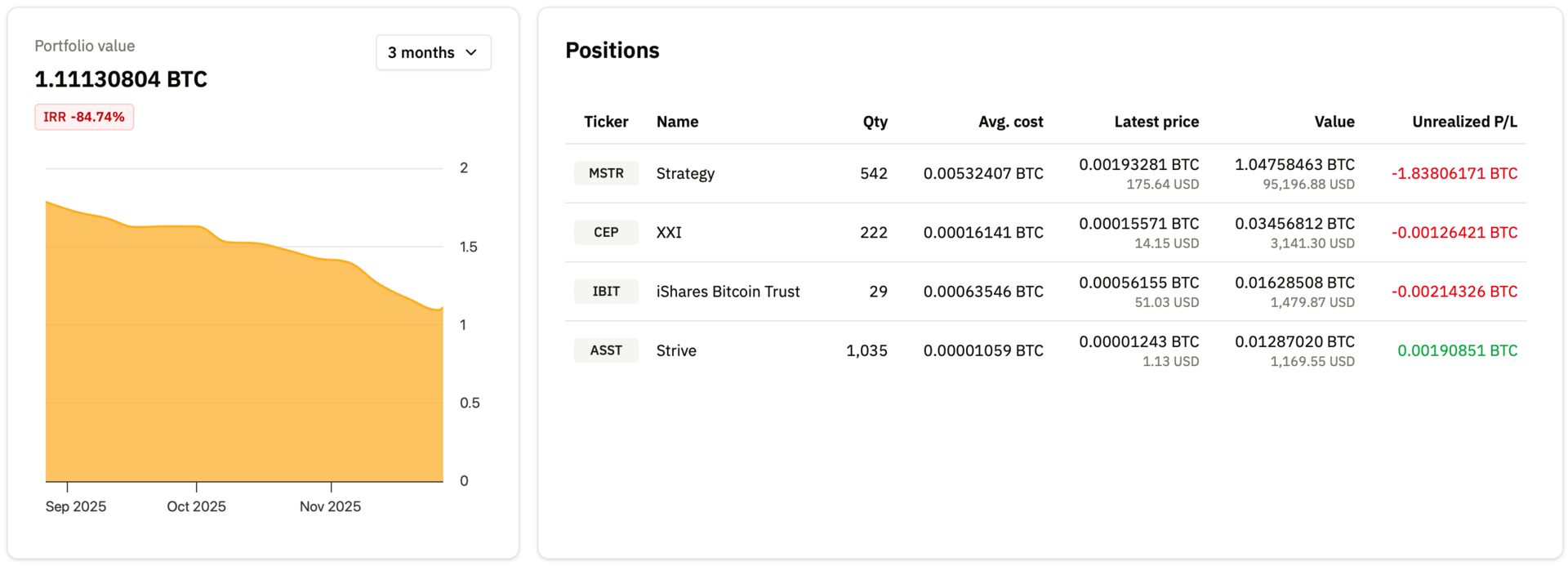
Portfolio of Bitcoin treasury stocks
We’ve created a live Bitcoin Treasury portfolio tracker that offers fresh data on market value, unrealized P/L, and IRR over a specific time period. Every position updates in real time so you can watch discounts to mNAV widen or close as catalysts play out.
Build your own basket → Bitcoin Treasuries Portfolio Tool
Select any public company, set your own weights, and benchmark against Bitcoin or major equity indices. Create watchlists, test strategies, and track NAV discounts — all in one dashboard.
Mining vs. Buying: How Bitcoin Treasuries Choose Their Accumulation Strategy
When assessing becoming a Bitcoin treasury, companies can choose from several strategies. One is to either buy Bitcoin on spot markets through capital raises, while another is to go down the mining route with operational infrastructure.
Conventional wisdom — despite the intricacies and capital costs that go into setting up a mining rig — has mostly favored mining. Produce coins cheaper than at market prices and then hold for price appreciation. But that thesis, especially at current market prices, is slowly evaporating. With the cost to mine one Bitcoin ranging from $87,000 to $101,000 per coin, according to a top mining CEO who spoke to BitcoinTreasuries, and Bitcoin trading at about $90,000, the cost differential has nearly vanished.
This means that treasury strategies, in many cases, diverge sharply. Strategy deploys hundreds of millions per week buying on spot markets while Bitdeer and Cango accumulate exclusively through mining operations.
Understanding why treasuries choose one path over the other reveals the structural tradeoffs that determine which companies can sustain accumulation through complete market cycles.
The split between buying and mining strategies appears clearly across the top 30 Bitcoin treasuries. Among the largest holders, pure capital markets buyers dominate, with Strategy (#1, 649,870 BTC), XXI (#3, 43,514 BTC), Metaplanet (#4, 30,823 BTC), and Coinbase (#8, 14,548 BTC). All of these firms accumulated through equity raises and spot purchases.
Mining-based treasuries, meanwhile, cluster in the middle tier. MARA Holdings (#2, 53,250 BTC), Riot Platforms (#7, 19,324 BTC), CleanSpark (#9, 13,011 BTC), and Hut 8 (#12, 10,278 BTC) represent the largest mining operations converted to treasury strategies. Further down the rankings, Cango (#17, 6,773 BTC) and American Bitcoin Corp (#25, 4,004 BTC) demonstrate the hybrid approach — mining operations that hold 100% of production rather than selling to cover costs.
Both groups reveal advantages at scale for spot buyers. No mining-based treasury has surpassed 60,000 Bitcoin despite years of operations, while Strategy accumulated more than tenfold that amount in five years through capital markets alone. MARA’s #2 ranking at 53,250 BTC required combining massive hash rate operations with occasional spot purchases funded by equity raises — effectively a hybrid model.
Just three pure-play miners — MARA, Riot Platforms, and Cleanspark — land in the top 10 compared to seven companies who have bought Bitcoin through capital raises, demonstrating that treasuries targeting top-tier holdings must eventually access capital markets regardless of their mining capacity.
Cryptio is an enterprise-grade accounting software platform built specifically for digital assets and cryptocurrencies. It enables businesses to transform blockchain transaction data from multiple exchanges and custodians into auditable financial records, supporting compliance with GAAP and IFRS standards.
For more information:
Even so, the economics behind the Bitcoin treasury trade have fundamentally shifted since it all began back in August 2020. When MicroStrategy, now rebranded to Strategy, pioneered corporate Bitcoin accumulation, mining offered clear unit-cost advantages. Produce at $20,000 to $30,000 per coin while spot Bitcoin traded at $40,000 to $60,000. Mining treasuries could hold production profitably while the few pure buyers paid market premiums.
Cost convergence
But the April 2024 halving changed everything.
Block rewards dropped to 3.125 Bitcoin from 6.25 Bitcoin while network hashrate has more than doubled, driving all-in production costs to $87,000 to $101,000 for efficient operations. Treasury companies evaluating the mining path now face near-parity economics: mine at $90,000 to $100,000 or buy spot at $90,000. Not to mention the upfront capital costs of building out an entire mining operation.
This cost convergence transforms mining from an obvious advantage to a strategic choice about operational complexity. Strategy’s model — raise capital through preferred equity and ATM offerings, then deploy immediately into spot purchases — prioritizes speed and scale over operational independence. The company’s 649,870 BTC treasury accumulated over five years would require building and operating 70-80 exahashes per second of mining capacity to replicate through production alone.
Track mining vs. buying strategies across all Bitcoin treasuries on our live dashboard: see which companies accumulate through operations, capital markets, or hybrid approaches.
That means constructing data centers, negotiating power contracts, procuring equipment, hiring technical teams, and managing ongoing operations. Michael Saylor chose capital markets expertise over mining operations expertise, betting that continuous fundraising ability matters more than production cost optimization.
Mining-based treasuries like Bitdeer and Cango make the opposite bet. By accumulating through hash rate rather than capital raises, these companies gain operational independence that sustains accumulation when capital markets close. Strategy’s $835 million preferred equity raise two weeks ago required investor appetite that can disappear during market stress. Just look at how MSTR’s premium has compressed to below 0.85x from 2.5x in July, making equity raises increasingly dilutive.
A clear tradeoff
Miners generate Bitcoin regardless of investor sentiment — electricity providers don’t care about Bitcoin volatility, they want payment for kilowatt-hours consumed. This creates year-round accumulation velocity independent of quarterly fundraising cycles.
The behaviour of recent treasuries shows the tradeoff clearly.
Strategy added 8,178 BTC last week through $835 million in preferred equity — a massive scale achieved in days. Meanwhile, Bitdeer added 202 BTC through mining operations in a slow accumulation process that required years of prior infrastructure investment. For treasuries prioritizing aggressive growth, buying delivers 40x the weekly accumulation velocity of mining. But that speed requires continuous capital access. If preferred equity markets close and ATM programs become prohibitively dilutive, Strategy’s accumulation stops entirely. Bitdeer’s accumulation continues as long as operations remain funded.
Compare accumulation velocity across the top 100 Bitcoin treasuries on our live dashboard: filter by mining-based vs. spot buying strategies and monitor which model compounds faster.
Capital structure differences compound over time as well. Strategy pays up to 12% annual dividends on preferred equity that theoretically can be deferred during times of market stress. Mining treasuries, meanwhile, pay electricity bills, equipment depreciation, and facility overhead. Those are tangible operational expenses that must be covered regardless of Bitcoin’s price.
Metaplanet’s Mercury preferred that yield 4.9% annually looks remarkably cheap compared to Strategy’s 10% to 12% STRC/SATA yields, but both pale in comparison against a miner’s operational costs.
Moreover, a treasury mining at $95,000 while Bitcoin trades at $90,000 burns $5,000 per coin produced. Even before considering equipment depreciation or facility overhead, it translates into a 5.5% negative carry. Treasury executives must evaluate whether operational losses today justify long-term positioning when costs remain fixed but Bitcoin potentially doubles.
The long-term optionality matters more than current economics. If Bitcoin rises to $150,000 to $200,000 over the next 12-24 months, mining costs likely remain anchored around $90,000 to $110,000 while spot buyers pay $150,000 to $200,000.
Monitor Bitcoin treasury capital structures on our live dashboard: track which companies use mining operations, preferred equity, convertible debt, or ATM programs to fund accumulation.
Treasuries that built mining infrastructure during the $80,000 to $100,000 range effectively locked in continuous production costs regardless of future spot prices, until the next halving. Strategy’s recent purchases at $102,000 demonstrate the alternative: treasury companies buying spot pay whatever the market demands. Neither approach guarantees superior returns, however. It depends entirely on whether management can sustain operations (mining) or capital access (buying) through volatility.
No clear winner
Revenue diversification also influences treasury strategy selection. Pure treasuries like Strategy hold Bitcoin and nothing else. When Bitcoin drops 50%, equity collapses in sympathy because there’s no operational business providing downside support.
Mining-based treasuries like Bitdeer operate data centers, manufacture equipment, and provide hosting services generating revenue independent of Bitcoin prices. This operational leverage means Cango’s 0.382x mNAV (62% discount to Bitcoin NAV) partly reflects value in the automotive services platform, not just Bitcoin holdings. Treasuries choosing mining gain business model diversification that pure treasuries can’t replicate.
Scale advantages heavily favor buying over mining for mega-treasuries, as the top 30 leaderboard demonstrates. Strategy’s 649,870 BTC exceeds the combined holdings of the three largest mining-based treasuries (MARA, Riot, CleanSpark reach roughly 85,585 BTC). Replicating Strategy’s treasury through mining alone would require controlling 8% to 9% of Bitcoin’s entire global hashrate — an impossible concentration requiring multi-billion-dollar infrastructure investments.
Even MARA (#2), the most successful mining treasury, holds just 8.2% of Strategy’s Bitcoin despite operating for years at a massive scale. For companies targeting 10,000+ BTC holdings, buying remains the only viable path to rapid accumulation.
Still, neither model “wins” outright. They both solve different problems for different treasury profiles. Mining provides independence and revenue diversification at the cost of operational complexity and current near-breakeven economics. Buying provides speed and scale at the cost of capital markets dependency and continuous dilution risk.
Treasuries must evaluate their core competencies and ask themselves a few questions. Can management run efficient mining operations through cycles, or maintain investor confidence for continuous capital raises?
The current $90,000 equilibrium — where mining costs roughly match spot prices — makes the strategic choice more important than the unit economics.
Special thanks to our partners:
o21 Solutions. o21 develops and implements Bitcoin-powered corporate strategy, transforming value chains with strategic expertise and tailored advisory services, with a focus on both Treasury and Operations - balance sheet accumulation, mining, and payments. Reduce cycle time through the corporate Bitcoin adoption journey through our pre-packaged or tailored engagements. Learn more: o21 Solutions
Cryptio. Cryptio is an enterprise-grade accounting software platform built specifically for digital assets and cryptocurrencies. It enables businesses to transform blockchain transaction data from multiple exchanges and custodians into auditable financial records, supporting compliance with GAAP and IFRS standards. Learn more: Cryptio
AnchorWatch. AnchorWatch makes Bitcoin ownership safer and easier by combining advanced custody expertise with industry-grade insurance. As a Lloyd’s of London Coverholder, it writers specialized policies that address digital-asset risks, giving clients trusted coverage and peace of mind. Learn more: AnchorWatch
Stacking Sats Inc. Official IT partner at BitcoinTreasuries, Stacking Sats Inc via its subsidiary, Framework IT, is a managed IT services firm with a 17-year track record of providing bet-in-class IT support, strategy, and cybersecurity, boasting high recurring revenue and long-term client contracts. It’s also one of the top 20 holders of Bitcoin among global private companies. Learn more: Stacking Sats Inc
Orange Wheel Advisors. Orange Wheel Advisors is a strategic consulting firm that helps companies navigate Bitcoin’s impact on corporate finance and competitive strategy. With expertise spanning treasury management, payments, capital structure, mining, and investor communications, they provide executive education, tailored strategies, and execution support to guide businesses through the global monetary transition. Learn more: Orange Wheel Advisors
Cadena Bitcoin. Cadena Bitcoin is a decentralized, non-custodial Bitcoin lending app that enables users to borrow and lend directly without intermediaries. Unlike centralized platforms, Cadena never takes custody of your Bitcoin, transactions are peer-to-peer and governed by transparent smart contracts, ensuring users maintain control of their assets. Learn more: Cadena Bitcoin
Secure Digital Markets (SDM) provides unparalleled liquidity, execution speed, and bespoke customer service, making it the top choice for institutional investors seeking reliable digital asset trading solutions. With deep expertise in capital markets and strict regulatory standards, SDM stands out as the premier platform for all digital asset treasury teams looking to optimize their trading and treasury operations. Learn more: Secure Digital Markets (SDM)
Over To You: What Do You Track?
We want to make this the go-to resource for corporate Bitcoin strategy — and that means learning from our readers.
What metrics or dashboards do you rely on to track the space?
Which signals would you like us to explore in more depth?
What tools would you like to see us integrate?
You can help shape the direction of this newsletter in 10 seconds.
Just hit reply, we read everything.